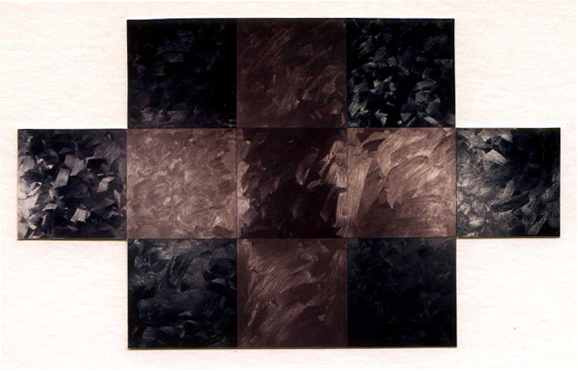
You, 72" x 120", oil on wood, 1988. Artist's collection.
These eleven 24" square panels were initially painted in a linear sequential manner similar to the method used in Orange Grid and Panel Cure in the Cartesian Grid Gallery. In this case I aligned the eleven panels and started with red paint at one end and continued mixing the complementary color (green) into the red paint on the palette so that by the eleventh panel, the brush was fully charged with dark green paint. Then I reversed direction with the (now) green brush and panel by panel integrated the pigment of the previous panel with the next--several times back and forth across all eleven panels until the once-opposing complementary hues (red and green) were integrated to the point wherein the disparate hues appeared to generate from an adjacent palette.
I had a 24" square matrix of nails in my studio wall leftover from painting Adjoin. It was easy to arrange these freshly painted 24" square panels on the wall in different configurations to see how I might finalize the composition. While I was painting these panels I used a lot of varnish and other mediums in the paint which gave a reflective quality and physicality to the paint. I knew that the panels were fine as they were individually but I had no idea about their arrangement as a group. I recall spending an evening or two shifting these panels around until I arrived at the final composition.
The painting itself is not provoking, but the title, You, is somewhat confrontational. Maybe it alludes to the "U" (universe) of C-Collage, or Bee Business, or maybe it is about you! I titled this painting You because I wanted the title to directly address the viewer in a manner befitting how the painting addresses the structure of all human perception--a conditional, parenthetical, and curiously unified melange of instincts and thought. There is a saying in the east--not the west (more duality)--that God is like a circle who's circumference is nowhere, but who's center is everywhere.
At the center of the composition is a six-panel crossing plan of warm hues--the central panel the darkest most visually anchored yet most mysterious. Metaphorically, the cross form represents the convergence of aspects of duality--up/down, good/bad, life/death, in/out, you name it (them). The central cross form is highlighted by the visually parenthetical existence of the surrounding dark panels which, if they may be allowed to integrate with the dark panel of the center cross, become cross forms as well whose centers are actually illuminated by the wings of the central cross form. Basic duality breeds multiplicity which breeds parenthetical structures of perception and thought. There You go.