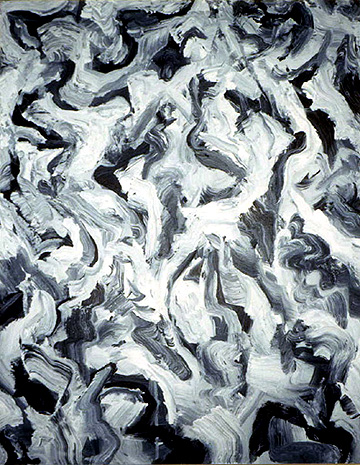
Throne, 30" x 24", acrylic on canvas, 1987. Private collection.
This painting was executed using roughly the same method as described in Two Handed Study. For this painting I was applying the paint in a more thick and opaque manner than in previous versions. This would account for the more polarized contrast between the black pigment and the white pigment. The paint was so thick that it became impractical to manipulate on the surface without turning the passages of pure black and white into a variation of gray. The compartmentalization of the pure black and pure white areas assist in giving this painting its intrigue in terms of illusionistic spatial topography.
The casual viewer of this type of work usually cannot get past the visual pyrotechnics of an arrangement of seemingly flat, non-representational, gooey brushstrokes of paint--fair enough. However, the same phenomenological visual laws which create pictorial space in any painting created throughout history also apply to abstract expressionist paintings. Iconography aside, it should not matter if one is speaking of Michelangelo, or, Jackson Pollack, the visual resonance of all visual art exists in the pictorial/spatial interplay of the symbiotic relationship of contrasting hues and tonalities arranged for the purpose of creating visual expression.