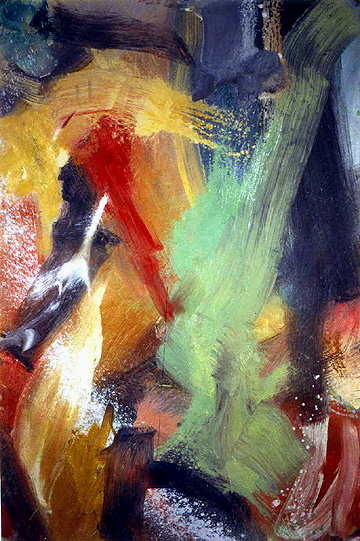
Space Chase, 44" x 26", oil on paper, 1987. Artist's collection.
A contemporary art critic once pointed out to me that the most intriguing formal aspect of Jackson Pollock's later work was not Pollock's flinging and dripping technique per se, but rather the spatial depth created in the layers of matrices of Pollock's "intuitively" applied paint. The colors and tones of Pollock's paint operate under the same phenomenological visual laws as any painting of any time. Relatively warm and bright pigments optically advance from the picture plane and relatively cool and dark pigments optically recede into the picture plane.
I consider this colorful, animated, and spatially complex painting to be a very high level of achievement in terms of my investigation of abstract expressionism. There is no conceptual recontextualizing happening here as with the previous few works. This is full-throttle, full-color plus black and white, abstract expressionism. There is a savage, irrational aspect to the composition which goes with the aggressive manner of how the paint was applied--literally striking and marking the surface with considerable force, or a quick jab and raking the paint across the surface. However, complimentary to the obvious savage aspect of the work, there is, for lack of a better term, an elegance in the order and balance of all the factors of this composition that absolutely rivets my attention on a deeper level.
At first glance, this painting is chaos incarnate--that was a significant part of my intention. Yet when I review formal considerations such as the compositional arrangement and interplay of colors of particular hues, the offset cantilevered manner in which the brushstrokes engage one another, the implied pictorial spatial depth created by the overlapping variations of hue and tone, the way in which the direction of the brushstrokes lead the eye in a circular fashion, and the way each corner of the picture plane is resolved by a different visual tactic. The presence of these formal issues within this chaotic composition suggest an implicit visual order which operates beyond the mere pyrotechnics of abstract expressionism.