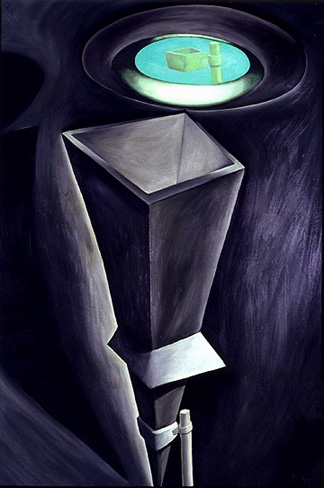
No Radio, 72" x 48", oil on canvas, 1986. Artist's collection.
The forms in this painting came from a simple intuitive sketch of an inverted, hollow pyramid with an elliptical orb shape resting on the inverted pyramid's back most corner. I immediately recognized the implicit figurative structure of the forms--the oval being the head, and the inverted pyramid being the body. In the original sketch the elliptical form was a portal, and the image viewed through the portal was a landscape. In the course of executing this painting, and considering these forms as being figurative, I began to see the elliptical portal (the head) as a monitor which, similar to a television, would broadcast the figure's thoughts as a visual image. Everything else in the composition, especially the inverted pyramid, appears to deal with earthly/temporal consciousness such as light and shadow, volume, mass, weight and gravity--especially in how the form of the inverted pyramid actually points downward and is wedged into a coupling device affixed to a pole which is presumably anchored to the ground. However the "thought-image" radiating from the portal has to do with a transcendent realm of higher consciousness in that all of the issues of light and shadow, volume, mass, weight and gravity have been diminished or eliminated entirely. The "figure" which exists in the physical realm of earthly concerns is actually visualizing the absence of its physical form from the coupling device. This symbolizes a shift of states of consciousness from the temporal--space and time, to the transcendent.
The image in the portal is painted in color as a visual foil to the rest of the painting which is painted in the highly polarized black and white chiaroscuro method I was using at the time. The inside of the hollow inverted pyramid has its own light source which emanates from within the form. The flange which appears on the lower half of the inverted pyramid is suggestive of an element of apparel such as a shirt collar or a skirt form. The shadow (at left) which is cast by the central form is curvilinear in nature suggesting that the central form resides in an orbicular environment which visually relates to the elliptical form of the portal. The shadow is rendered without the presence of the coupling device creating another reference to its metaphysical nature.