 This is the
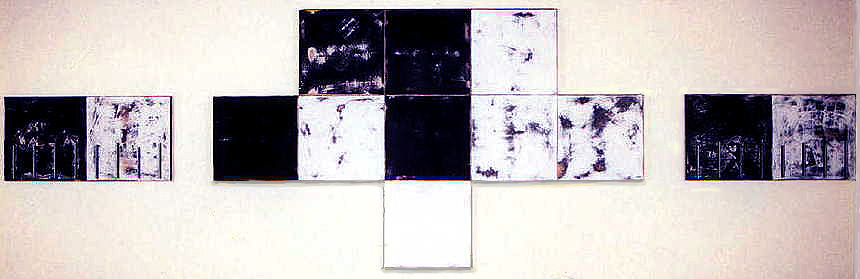
largest painting here at FryeWorks. The piece is twenty feet
long and is comprised of thirteen 24" x 24" panels. The panels
were individually prepared using the same multi-layered black and white
paint application and belt-sanded finishing technique as was previously
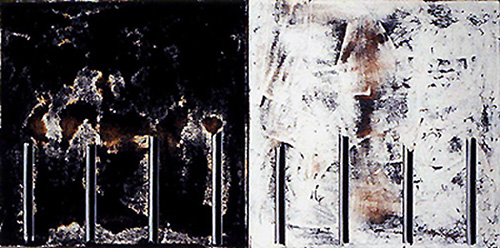
described in the discussion of Snap in this gallery. At left
is a detail of the far left element of the piece. The detail offers a better
view of the panel's surface articulation as well as the illusionistically
painted series of metal bars which relate to the "hoosegow"--a
colloquial term for "jail"--aspect of the title.
This is the
largest painting here at FryeWorks. The piece is twenty feet
long and is comprised of thirteen 24" x 24" panels. The panels
were individually prepared using the same multi-layered black and white
paint application and belt-sanded finishing technique as was previously
described in the discussion of Snap in this gallery. At left
is a detail of the far left element of the piece. The detail offers a better
view of the panel's surface articulation as well as the illusionistically
painted series of metal bars which relate to the "hoosegow"--a
colloquial term for "jail"--aspect of the title.
This was, like the previous painting You, a process-oriented work. Each panel was prepared individually, and each panel came through the process bearing a unique degree of transformation. The only pre-thought regarding the finished painting was that I knew the approximate size of the finished piece and that it required about fourteen panels. In this sense, preparing the "sets" of 24" square black and white panels was something like fashioning a deck of cards, or game pieces. Each card, or game piece, was uniquely predisposed to participate in the outcome of the composition--a visual puzzle, or stratagem which would reveal itself as the intuitive process continued. I began arranging the panels on the matrix of nails on my studio wall that I had used for the previous three multi-panel compositions.
The resulting composition is one which integrates a sequential rhythm on the central horizontal axis and addresses issues of spatial mass on the vertical axis. On the central horizontal axis the panels sequence (from left to right) from black to white across the composition. There is an interruption in that sequence, but that is a result of what is occurring on the vertical axis. The three black panels which are joined by their edges at the top and center of the composition visually conspire to create a massive form which implies a downward force from the top through the center of the composition. Adjacent to the three joined black panels are three white panels in the same configuration, but inverted, and visually describing a shift of mass in an upward direction. The single white square at the bottom of the overall composition participates in both the horizontal axis and vertical axis. The lower square absorbs the visual allusion of mass created by the configuration of the three dark panels on the vertical axis. The bottom square is also located at the center of the horizontal axis and operates as the visual fulcrum upon which the horizontal axis rests and retains its balance. Game over (and over).
Having satisfactorily set the arrangement of the panels, I felt that the the separated "wings" of the composition required a slightly enhanced visual attitude. I painted a sequence of thin equidistant cylinder forms on the surfaces of the wing panels. After some deliberation the sequence of cylinders appeared as architectural forms, or, metal bars in a prison cell--hence, the title. The "freedom" is the creative liberation I experienced in the intuitive process of creating this giant work. The "hoosegow"--a term I associate with pioneering, or frontiering the American West--relates to the more sobering creative decisions which progressively narrowed down to the ironic final inclusion of three-dimensional chiaroscuro forms on the wing panels. This brief clarification of verbiage in the title should not be misconstrued as my offering the overall meaning of the composition. The symbiotic relationship shared by issues of freedom, and imprisonment are merely one inflection of the universal issue of duality. Duality is merely the point of departure--hence, the title.