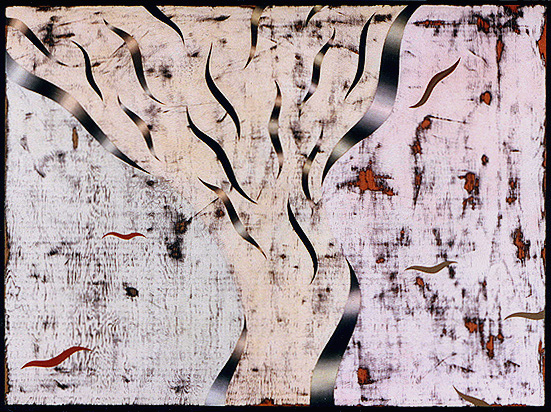
Equipoise, 36" x 48", oil and acrylic on wood, 1994. Artist's collection.
I attempt, though not always successfully, to speak of the images I make in an objective voice. However, there are certain events which have occurred in my life which factor into the making of certain images more than others. When I began working on the 3' x 4' wood panel that would become Equipoise I was returning from a four month involuntary abstinence from painting. The abstinence from painting--literally could not pick up a brush--resulted from the simultaneous convergence of two very unfortunate, and uncontrollable, events in my life. One event was witnessing a death in my family, and the other was something else.
The scale of the panel was the only predetermined factor in terms of physically initiating the work. I was devoid of preconceptions of imagery, and especially averse to making another Saint Helices composition. I was operating at the level of survival instinct. The panel began with the barest of tools and mediums--a large flat paintbrush, a can of white latex paint, a can of black latex paint, and an electric belt sander. I exhumed the process I had used six years earlier in preparing the panels for Snap--alternating layers of black and white paint and abrading the surface with a belt sander to reveal the layers of paint in areas, the grain of the wood, and the wood itself. Having accomplished this I carried the dead weight of the panel from the dirty workroom of my studio into the clean workroom to view the panel's surface under the studio lamps. I noticed that there were three distinct areas of the panel which related to the severity of how they were distressed by the belt sander. I made a pencil line delineating the distinctive areas of the panel. I lifted and turned the panel to view it at every angle of vertical and horizontal orientation and decided which direction of orientation made the most aesthetic sense to me. I then expanded the pencil lines delineating the separate areas by painting black undulating linear forms and added the smaller free flowing undulating forms in the central area also in black paint.
At that point the undulating forms gave the appearance of a tree form, or an aerial view of a river delta. It was a beautiful design, but the black undulating forms seemed schematic and flat. I decided to leave some of the black undulating forms as they were and paint the others as three-dimensional forms with a play of light. I also wanted to increase the sense of separateness of the three areas of the panel. I glazed the right area with red varnish, the center area with yellow varnish, and the left area with blue-green varnish. Then I glazed colored varnishes over the highlighted areas on the undulating forms. I pursued the "tree form" idea by painting horizontally oriented undulating forms in the lower left and right sides of the panel. The color of the "fallen" undulating forms on the left is the exact color of the color-toned bare wood patches on the right side of the panel, and vise-versa for the fallen forms on the right. There is one undulating form captured in mid-fall (flight?) in the upper portion of the right (red) area. It is rendered in both the red and green hues of the color-toned bare wood areas from both sides of the panel.
My usage of the word "equipoise" as the title of the painting refers to a condition of balance between states of motion and rest, presence and absence, generation and degeneration.