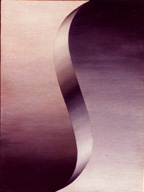
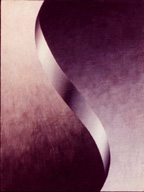
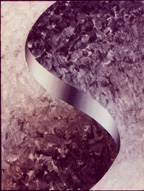
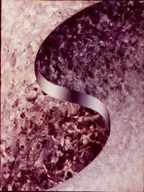
 This 12"
x 120" composition is comprised of a sequence of individual paintings
which is designed to operate on both the micro (each panel), and, macro
(all panels unified) levels of perception.
The title Course also operates with the micro/macro dynamic
in mind. The word "course" can be used in reference to both, the
concepts of time, and, space. In terms of time we say, "In the course
of...an hour...a day...one's life..., or, ...history...". In terms
of space, we say "race course", or, "obstacle course",
or, in the verb tense, blood "courses" through one's veins.
This 12"
x 120" composition is comprised of a sequence of individual paintings
which is designed to operate on both the micro (each panel), and, macro
(all panels unified) levels of perception.
The title Course also operates with the micro/macro dynamic
in mind. The word "course" can be used in reference to both, the
concepts of time, and, space. In terms of time we say, "In the course
of...an hour...a day...one's life..., or, ...history...". In terms
of space, we say "race course", or, "obstacle course",
or, in the verb tense, blood "courses" through one's veins.
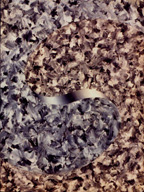
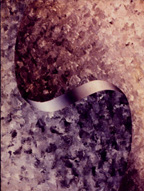
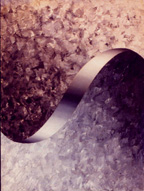
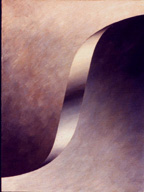
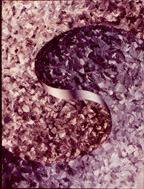
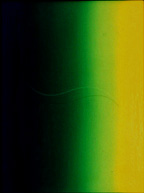
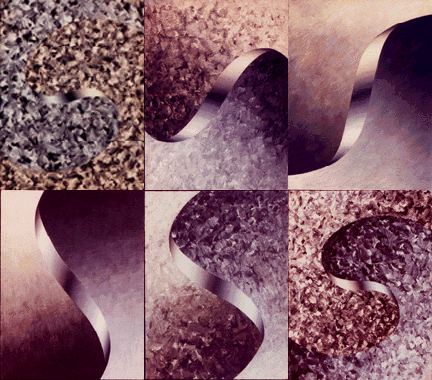
This painting is not only a linear sequence of images, it is also a "loop" of images in that the size and orientation of the curvilinear form in the tenth panel is exactly the same as the form in the first panel. Essentially, the sequence ends where it began, and begins again. The form in question here is a spatially anomalous edge form--exactly like the Saint Helices edge forms--which delineates two distinct areas in each composition. The edge form also determines the atmospheric and/or three-dimensional status of the adjoining two pictorial areas in each panel. The edge form is also an autonomous form unto itself.
At the beginning of the sequence/loop, the edge form is small and horizontally oriented with the picture plane. The two areas adjoining the edge form in the initial panel are rendered as chaotic fields of black and white pigment, glazed in opposing hues (warm and cool). The long, continuous sweep of their interlocking outlines nearly envelope the edge form. In the following few panels, the edge form grows in scale and rises from a horizontal, to a more vertical orientation with the picture plane. Concurrently, the adjoining areas unenvelope the edge form and the factors of their rendering, while remaining opposed color-wise, begin to soften, blend, and clarify. Incidentally, the angle of orientation of the play of light in the adjoining areas of the edge form is always perpendicular to the angle of orientation to the edge form in each sequential panel. By the middle of the sequence the edge form is fully vertical and achieves a scale wherein its form brushes the top and bottom edges of the picture plane. At this point, the areas adjoining the edge form are rendered as smooth atmospheric modulations of dark and light which almost mirror the rendering of the edge form itself. As the sequence continues, the edge form adopts a more horizontal orientation to the picture plane and diminishes in scale. The adjoining areas begin to wind tighter upon one another and the dark and light factors of their luminosity begin to coagulate into a more fragmentary appearance. The last panel is composed of a raised sculptural relief of the edge form in an exact horizontal orientation (as in the first panel) and is bathed in an extreme presence of light which is foreign to the color scheme of the previous nine panels. The scheme of variations of red and blue (warm and cool) hues which directed the course of color events in the composition up to this final panel is devoid of the portion of the spectrum wherein pure blue transmutes through permutations of green, and into pure yellow. This ending/beginning panel represents the pure blue to pure yellow passage of the spectrum exclusively, and creates a necessary visual breach in the sequence/course in the form of an ironic, metaphorical settling of pictorial accounts so that the new life (panel one) may recommence unabated. The last panel represents the point of interface where the generation of the sequence/course fully degenerates, and the degeneration of the sequence/course fully regenerates. Lovely.