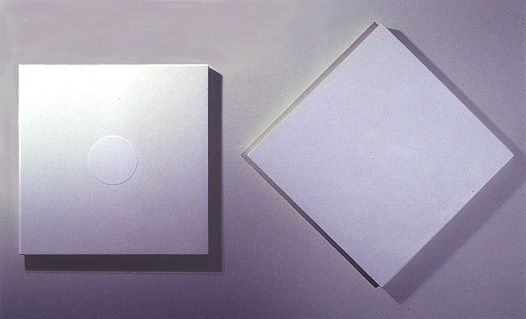
In Our Angelhood, 24" x 60", acrylic and assemblage on wood, 1988. Artist's collection.
This work is comprised of two 24" square panels which were painted white and sanded to a smooth finish. The only visual form on the surface of the panels is a slightly raised circle form on the left panel. The top edge of the circle reflects a highlight, and the bottom edge of the circle casts a shadow. In a sense, light itself becomes the medium of this ethereal work.
The right square panel is turned and oriented on its diagonal axis which is uncharacteristic of the implicit grid system of the previous works in this gallery. However, the quarter turn of the right panel is a "circular" movement. The right panel's orientation in the piece results from its fixed center point. The circular movement of the panel radiates from that center point. This is how the two panels interrelate visually and conceptually. Both square panels participate in a discussion of a circular form--the left panel explicitly, and the right panel implicitly. Reflected light radiates from the raised circle of the left panel, and the circular movement of the right panel radiates from its fixed center point.
The title of this piece was appropriated from a lyric in a song that I was fond of at the time. I was in my twenties when I applied that title to the work. I was glad to have some level of literary/metaphorical reference for what I sensed was happening in this painting. Today I might title the work differently, something like, "Yes, Darling." Because this painting is about the concept of acquiescence, or, what is known in music as "call and response". There is a direct interplay between the two panels wherein one panel visually suggests an attitude, or, idea, and the other panel responds directly--acquiescing to, or, addressing the message of its partner. There is also a an implicit interplay in this work which addresses broader concepts of cause and effect, duality, and the radiant properties of light, time, and, space.